
From Programs to Enterprise: Trends from 5 Years of SPARC Data
 Over the past five years, auxiliary programs in independent schools have undergone a meaningful shift. What was once often treated as a collection of individual programs — summer camp, after-school care, enrichment, rentals, school stores, special events — is increasingly functioning as something larger: a school enterprise.
A collection of programs is managed one activity at a time. Each has its own calendar, staffing needs, budget, and operational rhythm. Success is measured by enrollment, participation, or whether the program "ran well." An enterprise, by contrast, is managed as an interconnected portfolio. It has a clear financial purpose, a strategy for growth, defined markets, shared systems, coordinated staffing, measurable outcomes, and a direct relationship to the broader goals of the institution.
The SPARC Compensation and Position Survey data from 2022 through 2026 suggests that auxiliary programming is moving steadily in that direction.
The Financial Scale Has Shifted Fast
One of the clearest signals is financial scale. In 2022, about 42% of responding schools reported more than $500,000 in annual auxiliary revenue; by 2026, that figure had climbed to roughly 78%. The share reporting $1 million or more nearly quadrupled, rising from about 16% to 53%.
This doesn't mean every school should aspire to build a multi-million dollar operation. It does mean that auxiliary programs increasingly represent a meaningful financial component of the school rather than a peripheral activity, and that the "average" auxiliary program today looks nothing like the average program five years ago.
Compensation has moved in the same direction. The average full-time Auxiliary Director salary increased from $84,324 in 2022 to $103,841 in 2026, an increase of approximately 23%. Median compensation rose from $80,000 to $100,000 over the same period. Higher-revenue programs are also more likely to compensate their Directors at higher levels, reinforcing the relationship between organizational scale and leadership responsibility.
The Role Itself Is Professionalizing
The structure of the role is changing as well. In 2022, only about a quarter of Directors were exclusively focused on auxiliary work, with no other departmental duties. By 2024 that figure had risen to 47%, and it has held in the high-40s through 2026.
That's an important marker of professionalization. Schools are increasingly recognizing that leading a complex portfolio of revenue-generating programs isn't simply an additional duty to be layered onto another position, it's a job in its own right.
The Organization Hasn't Caught Up
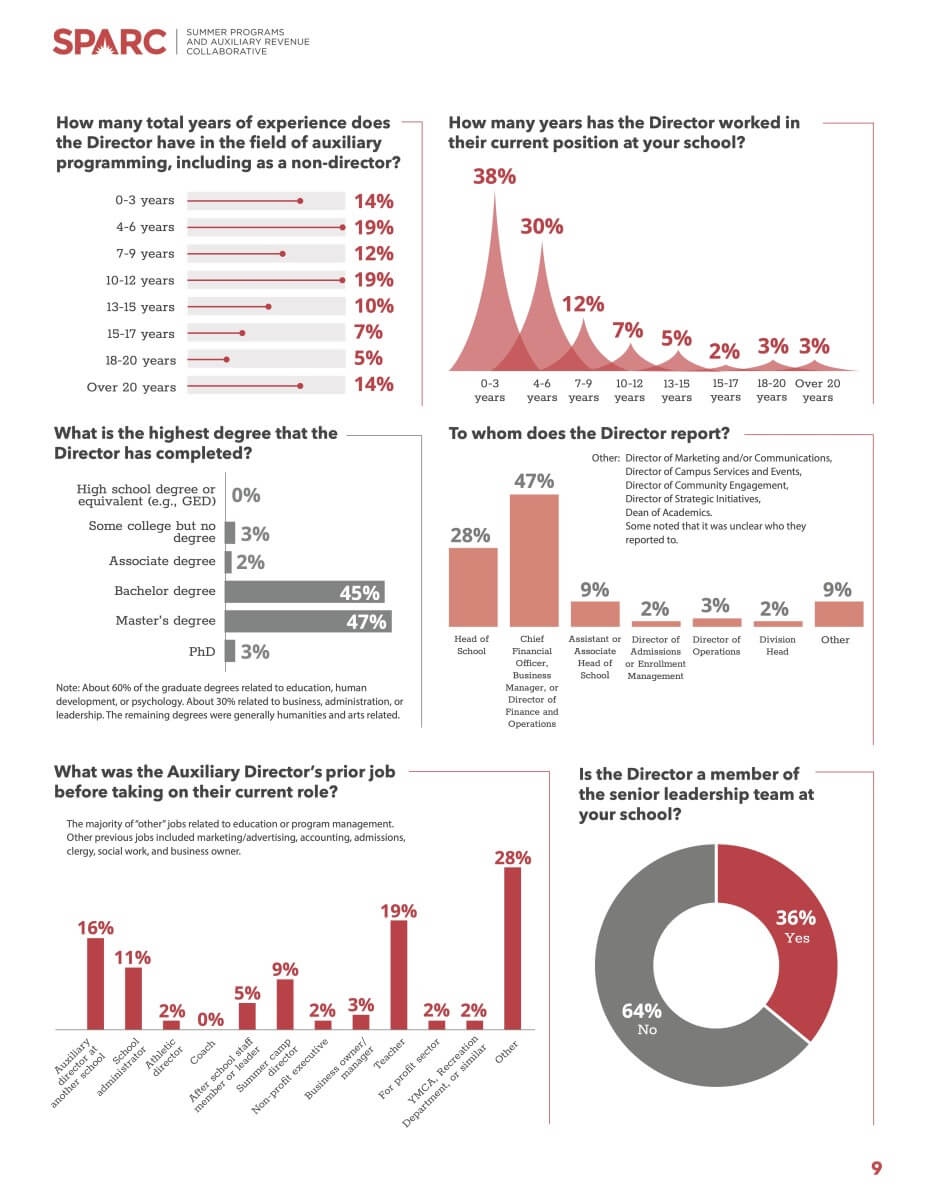
Although the enterprise is growing, the organizational model around it hasn't kept pace. Roughly half of Directors still carry responsibilities outside of auxiliary programs and departments remain relatively lean. Only about a third of Directors sit on their school's senior leadership team — 33% in 2024, 34% in 2025, 36% in 2026 — a figure that has barely moved despite the sharp growth in auxiliary revenue over the same years. Succession planning tells a similar story: a meaningful share of the field's most experienced Directors now name retirement as their next step, with no clear leadership pipeline visible behind them.
An enterprise generating a growing share of school revenue is being run, in most cases, without a seat at the table where the school's other major decisions get made.
What Enterprise Management Actually Requires
An enterprise requires more than program management: it requires strategic planning, pricing discipline, staffing systems, and ongoing portfolio evaluation. It requires leaders who don’t just ask "how do we run this program well?" but "where should we invest?, “what should we stop doing?”, and “what capacity do we need to serve the markets we're already in?"
The 2026 survey reflects exactly this shift. Directors identified time for strategic planning, insufficient staffing, and marketing effectiveness among their most significant challenges. The problem increasingly isn't a lack of ideas or mission clarity — those rank among the least significant challenges Directors report. It's the ability to execute strategically at a higher level than the role is currently resourced for.
That may be the defining auxiliary challenge of the next five years.
Where Schools Go From Here
Schools have already demonstrated that auxiliary programs can substantially extend and support the mission: generating revenue, serving current families, introducing prospective families to the institution, activating campus facilities, and strengthening community. What comes next is less about proving that auxiliary programs matter and more about building the organizational conditions that let them succeed.
Two changes would go a long way:
- Include the Director in strategic conversations — not just auxiliary-specific ones, but the budget, facilities, and enrollment discussions that already depend on auxiliary revenue.
- Build a named succession plan for auxiliary leadership, particularly at schools whose most experienced Directors are within a few years of retirement.
Thinking of auxiliary as an enterprise doesn't mean making schools more commercial. It means managing a significant, and rapidly growing, part of school operations with the discipline, intentionality, and strategic access that its scale now requires.
The evolution is already underway. The opportunity now is for school structures, staffing, leadership access, and investment to catch up.
Members can access the 2026 SPARC Compensation and Position Report in in SPARC Connect. Non-members can purchase a copy of the report on our website.